SDG 13 : Climate Action
SDG 13 “climate action” strives for rapid response to fight climate change and its impact. It focuses extreme value on increasing resilience, combining policy with climate action, and increasing public knowledge of climate challenges
UNIMAS prioritizes low-carbon energy use, seeking energy-efficient solutions and renewable energy sources to minimize its carbon usage. UNIMAS places a strong emphasis on environmental education, raising awareness and sharing knowledge about climate change and sustainable practices within campus and outside campus. UNIMAS has dedicated to becoming a carbon-neutral university, actively working to reduce greenhouse gas emissions and offsetting its carbon impact through sustainable initiatives.
13.2 Low carbon energy use
13.2.1 Low-carbon energy tracking
Universiti Malaysia Sarawak (UNIMAS) demonstrates its commitment to climate action and sustainable campus operations through its Energy Policy and Low Carbon Campus Roadmap 2030. These initiatives emphasise the importance of improving energy efficiency, optimising energy consumption, reducing greenhouse gas (GHG) emissions, and encouraging the adoption of renewable energy across whole university operations.
Through its Low Carbon Campus Roadmap 2030, UNIMAS aims to reduce energy consumption and increase the share of renewable energy by 30% compared with the 2022 baseline, as part of its broader commitment to achieving a low-carbon campus by 2030. The university also highlights the importance of energy management, GHG emissions monitoring, and the implementation of energy-efficient practices to support its climate action objectives. These efforts contribute to reducing the environmental impact of campus activities while promoting more responsible energy use among the university community.
In 2025, UNIMAS monitored its total electricity consumption and renewable energy production across the university through official energy records. The university recorded a total electricity consumption of 45,884,378 kWh, while 92 kWh was generated from renewable sources via the Solar Photovoltaic (PV) system installed at the Academic Block, Central UNIMAS Building for Educators (The CUBE). Renewable energy production accounted for approximately 0.0002% of the university's annual electricity usage, reflecting ongoing efforts to integrate clean energy technologies into campus operations and support institutional sustainability goals.
Keyword: monitored its total electricity consumption, renewable energy production, official energy records, recorded a total electricity consumption of 45,884,378 kWh, annual electricity usage, energy management, GHG emissions monitoring
13.2.2 Low-carbon energy use
| Energy Indicator | Value |
|---|---|
| Total Energy Used | 45,884,378 kWh |
| Total Energy Used from Low-Carbon Sources | 92 kWh |
| Proportion of Energy from Low-Carbon Sources | 0.0002% |
During 2025, the institution consumed a total of 45,884,378 kWh of energy, of which 92 kWh was sourced from low-carbon energy systems. This represents approximately 0.0002% of total energy consumption.
13.3 Environmental education measures
13.3.1 Local education programmes on climate
Asia-Pacific Seminar on Climate Change and Energy Transition: Strengthening Dialogue for a Just and Inclusive Future
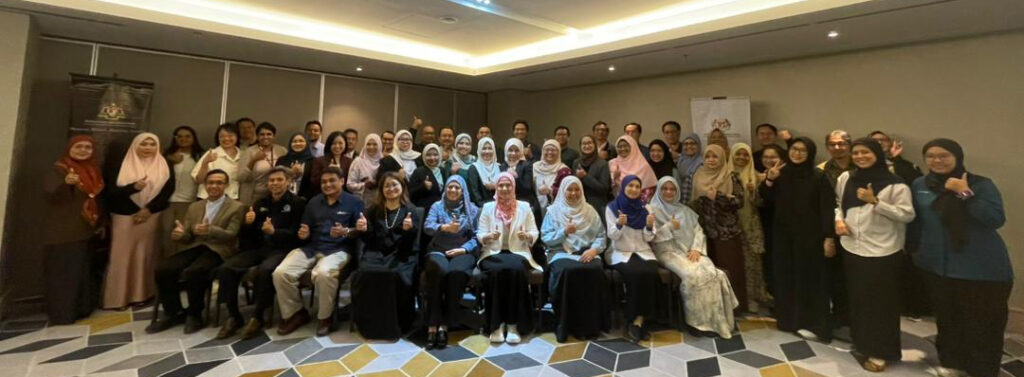
The International Seminar on Asia-Pacific Perspectives on Climate Change and the Energy Transition: Reflections from Malaysia, Australia and Japan was held on 2 October 2025 at Dayak Cultural Foundation in Kuching. Hosted by UNIMAS in partnership with the University of Malaya, Curtin University Malaysia and Nagoya University, Japan, the event brought together diplomats, academics, policymakers and civil society to exchange regional perspectives on achieving a fair and sustainable energy transition. The seminar explored climate governance and policy, clean-energy technologies such as hydrogen and carbon capture, green finance, ESG and corporate transparency, and the importance of Indigenous knowledge, human rights and community participation. The event promoted regional cooperation and dialogue to support decarbonisation, climate action and an inclusive transition to a low-carbon future.
Keyword: Seminar; Climate Change; Energy Transition; Exchange Regional Perspectives; Climate Governance and Policy; Clean-Energy Technologies; Community Participation; Regional Cooperation; Climate Action; Low-Carbon Future
Reference Link: Asia-Pacific Seminar on Climate Change and Energy Transition: Strengthening Dialogue for a Just and Inclusive Future 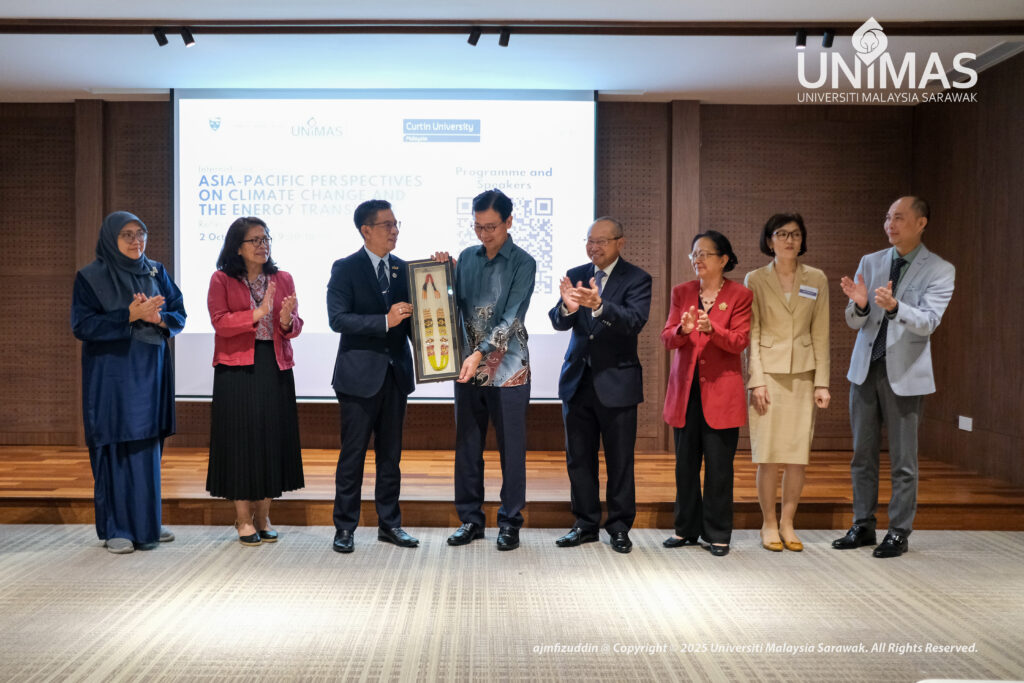
Learning the SDGs the Creative Way at FSSH UNIMAS
On 21 November 2025, the Faculty of Social Sciences and Humanities (FSSH), UNIMAS successfully hosted the “Building a Better World: School Sustainability Toolkits 2025” Exhibition. As part of the CARE (Community Resilience Experiential Learning) Framework, second-year Development Planning and Management student designed interactive booths to educate 60 students and six teachers from SMK Muara Tuang covering the 17 Sustainability Development Goals (SDGs). The exhibition included renewable energy demonstrations using water turbines, solar panels and wind power to help participants understand clean-energy alternatives and their role in environmental sustainability. This initiative provides climate education and awareness within the local community.
Keyword: Sustainability Development Goals (SDGs); Educate; Renewable Energy Demonstrations; Water Turbines; Solar Panels; Wind Power; Clean-Energy Alternatives; Environmental Sustainability; Climate Education; Awareness; Local Community
Reference Link: Learning the SDGs the Creative Way at FSSH UNIMAS

E-Waste is a Silent Killer, What We Throw Today Will Poison Our Tomorrow
A Service Learning Malaysia (SULAM) project titled There is Us in Sustainability was conducted on 25 June 2025 by 18 International Relations students from the Faculty of Social Sciences and Humanities (FSSH), UNIMAS, in collaboration with Green Sky Enterprise. The project aimed to raise awareness among the UNIMAS community about environmental and health hazards of improper electronic waste (e-waste) disposal. Improper e-waste disposal can cause soil and water pollution caused by hazardous heavy metals such as lead, mercury and cadmium. The project supported SDG 12: Responsible Consumption and Production and SDG 13: Climate Action by encouraging responsible waste management and environmentally sustainable practices. Students collected more than 120 kg of e-waste and gathered other recyclable materials for proper disposal. The initiative also promoted community engagement, environmental awareness and student responsibility.
Keyword: SULAM Project; Raise Awareness; UNIMAS Community; Environmental and Health Hazards; Improper E-Waste Disposal; Soil and Water Pollution; Responsible Waste Management; Environmentally Sustainable Practices; Climate Action; Environmental Awareness; Community Engagement; Student Responsibility
Reference Link: E-Waste is a Silent Killer, What We Throw Today Will Poison Our Tomorrow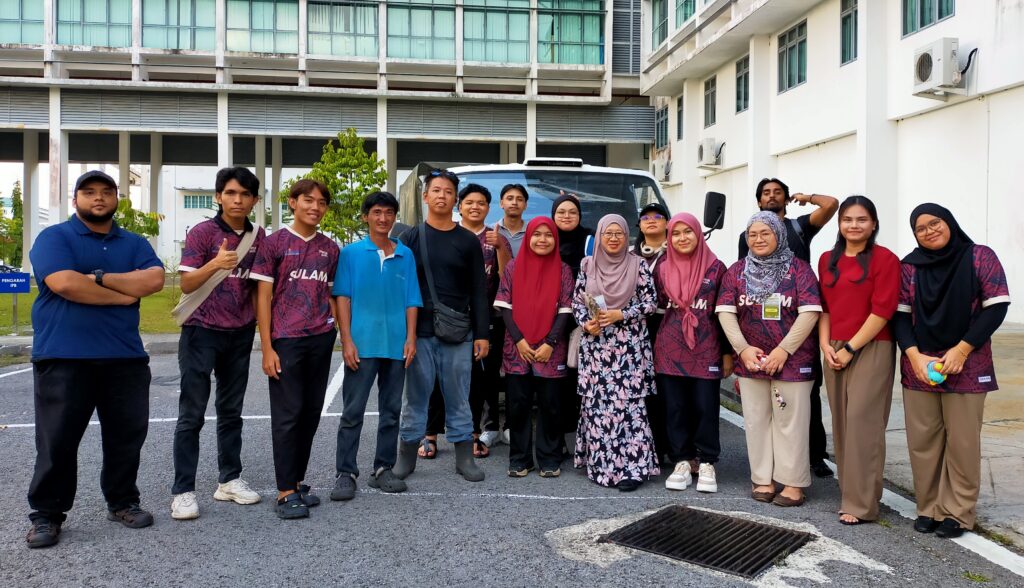
13.3.2 Climate Action Plan, shared
UNIMAS Low-Carbon Roadmap 2030
UNIMAS is committed to driving campus-wide decarbonisation and strengthening climate resilience through its long-term sustainability initiatives and strategic planning frameworks. Through the implementation of its Low Carbon Campus Roadmap 2030, the university has established a clear pathway to reduce greenhouse gas emissions, improve energy efficiency, increase the adoption of renewable energy and promote sustainable practices across campus operations. These efforts support the transition towards a low-carbon future while fostering climate awareness and participation among the university community. The roadmap is publicly communicated and aligned with broader regional sustainability priorities, directly supporting Sarawak's green economy aspirations and capacity-building goals under the Post COVID-19 Development Strategy 2030 (PCDS 2030), particularly within the environmental services sector. By sharing its climate commitments, targets, and progress with stakeholders, UNIMAS demonstrates transparency and accountability in advancing climate action at both institutional and regional levels.
Keyword: Low Carbon Campus Roadmap 2030; Decarbonisation; Climate Resilience; Climate Action; Greenhouse Gas Emissions Reduction; Climate Commitments; Targets and Progress; Publicly Communicated; Transparency and Accountability; PCDS 2030 Alignment.
 Reference Link: Post COVID-19 DEVELOPMENT STRATEGY 2030
UNIMAS Environmental, Social and Governance (ESG) Policy
UNIMAS outlined its environmental initiatives to achieve UNIMAS Low Carbon Campus Roadmap 2030 in order to reduce the university’s environmental footprint and support global efforts to reduce climate change effects.
Energy
UNIMAS is committed to reducing energy consumption and increasing renewable energy usage such as the usage of solar technology. Further expansion of solar energy capacity will be prioritized at the same time adopting energy-efficient technologies and policies.
Greenhouse Gas Emissions
UNIMAS aims to reduce its greenhouse gas emissions through solar energy initiatives, energy efficiency improvements and sustainable operational practices that help to reduce the overall carbon footprint of the university.
Keywords: UNIMAS Low Carbon Campus Roadmap 2030; Environmental Initiatives; Energy Consumption Reduction; Renewable Energy Usage; Solar Technology; Energy-Efficient Policies; Greenhouse Gas Emissions Reduction; Energy Efficiency Improvements; Sustainable Operational Practices; Carbon Footprint Reduction.
UNIMAS Sustainability Masterplan 2021-2025
The UNIMAS Sustainability Masterplan 2021-2025 provides a comprehensive framework for climate action, integrating sustainability across teaching, research, campus management and community outreach. Aligned with the UNIMAS Low-Carbon Campus Roadmap 2030 and Sarawak’s state sustainability goals, the masterplan embeds climate targets into institutional resource allocation and stakeholder collaboration.
Keywords: Sustainability Masterplan 2021–2025; Comprehensive Framework for Climate Action; Low-Carbon Campus Roadmap 2030; Climate Targets; Stakeholder Collaboration; Institutional Resource Allocation; Sustainability Integration; Community Outreach; State Sustainability Goals.
UNIMAS Becomes the First Public University in Malaysia to Publish an ESG Report and Adopt a University-wide ESG Policy
UNIMAS commitment to sustainability through the publication of its Environmental, Social and Governance (ESG) Report and implementation of a university-wide ESG Policy. The policy integrates sustainability into teaching, research, campus operations and community engagement to align with Malaysia’s national ESG agenda and Sarawak’s Green Economy Policy. UNIMAS has also introduced its Sustainability Masterplan, developed a Low-Carbon Campus Roadmap and established a greenhouse gas (GHG) Dashboard to support its sustainability efforts. In addition, the university collaborated with the International Labour Organization (ILO) to develop ESG training modules for small and medium enterprises (SMEs).
Keyword: ESG Report; University-wide ESG Policy; Sustainability Masterplan; Low-Carbon Campus Roadmap; Greenhouse Gas (GHG) Dashboard; Sustainability Governance; Climate Action Planning; GHG Monitoring; Low-Carbon Development; Sarawak Green Economy Policy.
Reference Link: UNIMAS Becomes the First Public University in Malaysia to Publish an ESG Report and Adopt a University-wide ESG Policy
13.3.3 Co-operative planning for climate change disasters
1. Local
Post-Flood Assistance Program February 2025: Collaboration between the UNIMAS Civil Engineering Department, UNIMAS Water Centre, PEKAMARA, and Yayasan Hasanah to Aid Affected Communities
From 17 to 19 February 2025, the Civil Engineering Department at UNIMAS, in collaboration with the UNIMAS Water Centre, PEKAMARA, and Yayasan Hasanah, executed the Sarawak Prihatin Flood Mission. Mobilizing around 50 volunteers including UNIMAS staff, Civil Defence Force (APM) personnel, and engineering students. The team provided vital post-flood assistance to five severely affected villages: Kampung Siol Kandis, Kampung Kudei, Kampung Endap, Kampung Tanjung Tuang and Kampung Hulu Serian. Over three days, volunteers distributed essential food rations and hygiene kits to aid family recovery while offering civil engineering students invaluable hands-on experience in disaster response and community rehabilitation.
Keywords: Collaboration; Sarawak Prihatin Flood Mission; Disaster Response; Civil Defence Force (APM); Post-Flood Assistance; Flood-Affected Communities; Community Rehabilitation; Community Recovery.
Reference Link: Post-Flood Assistance Program February 2025 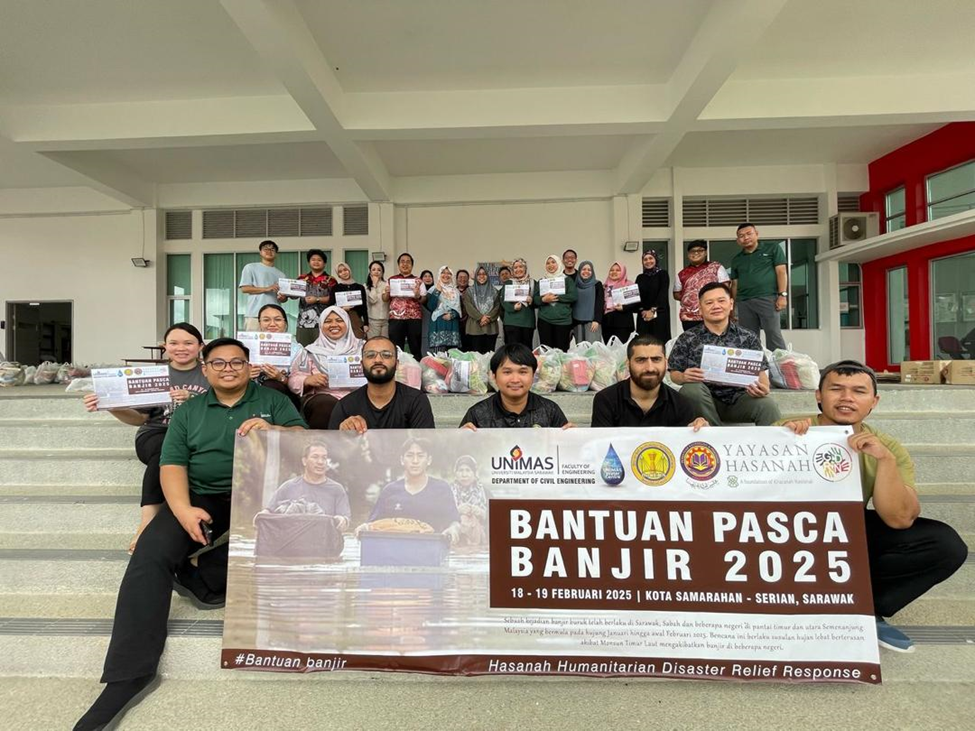
Disaster Simulation (Post-Flood) and Emergency Disaster Relief Workshop at Universiti Malaysia Sarawak (UNIMAS) - 2025
On 5 September 2025, Universiti Malaysia Sarawak (UNIMAS) hosted 84 student volunteers from 20 public universities across Malaysia for the Disaster Simulation Workshop (Post-Flood) and Emergency Assistance During Disasters, held at Dewan Kristal as part of the 2025 National Humanitarian Assistance and Disaster Relief (HADR) Mission Program organized by MASKUM. Facilitated by the Civil Defence Force (APM) Sarawak alongside the UNIMAS Kor SISPA following its 4 September opening officiated by the Deputy Vice-Chancellor (Student Affairs & Alumni), the one-day workshop delivered vital theoretical and practical modules covering National Disaster Management Agency (NADMA) Directive No. 1, volunteer roles in post-disaster recovery, emergency first aid, and evacuation center management simulations. This initiative enhances institutional disaster preparedness, strengthens youth capacity in emergency response, and equips future leaders with the practical skills needed to mitigate climate-induced flood risks and build community resilience across Malaysia.
Keyword: NADMA Directive No. 1; Disaster Simulation Workshop; HADR Mission Program; Post-Disaster Recovery; Evacuation Centre Management; Disaster Preparedness; Emergency Response; Climate-Induced Flood Risks; Community Resilience; Multi-Stakeholder Collaboration.
Angkatan Pertahanan Awam Malaysia (APM) Sarawak
2. Regional
January 2025 Flooding in Sarawak
UNIMAS published a detailed climate impact analysis on the severe January 2025 Sarawak floods, incorporating hydrological research from Assoc. Prof. Ir. Dr. Charles Bong Hin Joo alongside data from Sarawak iHydro, MET Malaysia, and the IPCC Sixth Assessment Report. The study evaluated rainfall return periods, urban drainage limitations, and compound tidal risks across affected divisions like Bintulu, Miri, and Kuching. By providing scientific data and engineering evaluations on local flood resilience and infrastructure performance, UNIMAS directly supports government agencies such as the Department of Irrigation and Drainage (JPS) and the Sarawak Disaster Management Committee in refining flood mitigation policies, infrastructure capacity, and regional disaster adaptation strategies.
Keyword: Climate Impact Analysis; Flood Resilience; Scientific Data; Engineering Evaluations; Flood Mitigation Policies; Regional Disaster Adaptation Strategies; Department of Irrigation and Drainage (JPS); Sarawak Disaster Management Committee.
Universiti Malaysia Sarawak (UNIMAS)
13.3.4 Inform and support government
January 2025 Flooding in Sarawak
UNIMAS published a detailed climate impact analysis on the severe January 2025 Sarawak floods, incorporating hydrological research from Assoc. Prof. Ir. Dr. Charles Bong Hin Joo alongside data from Sarawak iHydro, MET Malaysia, and the IPCC Sixth Assessment Report. The study evaluated rainfall return periods, urban drainage limitations, and compound tidal risks across affected divisions like Bintulu, Miri, and Kuching. By providing scientific data and engineering evaluations on local flood resilience and infrastructure performance, UNIMAS directly supports government agencies such as the Department of Irrigation and Drainage (JPS) and the Sarawak Disaster Management Committee in refining flood mitigation policies, infrastructure capacity, and regional disaster adaptation strategies.
Keyword: Climate Impact Analysis; Flood Resilience; Scientific Data; Engineering Evaluations; Flood Mitigation Policies; Regional Disaster Adaptation Strategies; Department of Irrigation and Drainage (JPS); Sarawak Disaster Management Committee.
Universiti Malaysia Sarawak (UNIMAS)
Early Flood Forecast - Sarawak
Through specialized research entities like the UNIMAS Water Centre, the university actively supports state and national government agencies including the Department of Irrigation and Drainage Malaysia (JPS) and the National Flood Forecast and Warning Centre (PRABN) by amplifying official early flood forecasts and continuous rain advisories. In December 2025, UNIMAS extended public reach for government flood warnings across high-risk river basins in Betong, Bintulu, Kapit, Kuching, Limbang, Miri, Serian, Sri Aman, Sibu, and Mukah. By issuing proactive safety advisories and guiding communities to official government portals (such as PublicInfoBanjir), UNIMAS directly enhances local disaster readiness, climate risk awareness, and government-led climate adaptation efforts.
Keyword: Supports State and National Government Agencies; Department of Irrigation and Drainage Malaysia (JPS); National Flood Forecast and Warning Centre (PRABN); Official Early Flood Forecasts; Government Flood Warnings; PublicInfoBanjir; Climate Risk Awareness; Government-Led Climate Adaptation Efforts.
UNIMAS Water Centre
Asia-Pacific Seminar on Climate Change and Energy Transition: Strengthening Dialogue for a Just and Inclusive Future
On 2 October 2025, Universiti Malaysia Sarawak (UNIMAS), in collaboration with the University of Malaya, Curtin University Malaysia, and Nagoya University, hosted the Asia-Pacific Seminar on Climate Change and Energy Transition: Strengthening Dialogue for a Just and Inclusive Future, bringing together policymakers, diplomats, academics, and civil society representatives to discuss climate action and sustainable energy transition. The seminar featured a dedicated session on Climate Change Governance and Policy, where experts examined emerging governance frameworks, international cooperation, and the importance of aligning national policies with global commitments to achieve net-zero goals. Discussions also emphasized policy coordination and fostering partnerships that bridge research and policymaking, demonstrating UNIMAS' active role in informing and supporting government decision-making on climate change, in line with SDG 13.3.4 (Inform and Support Government).
Keyword: Policymakers, Climate Change Governance and Policy, Emerging Governance Frameworks, Aligning National Policies with Global Commitments, Policy Coordination, International Cooperation
Reference Link: Asia-Pacific Seminar on Climate Change and Energy Transition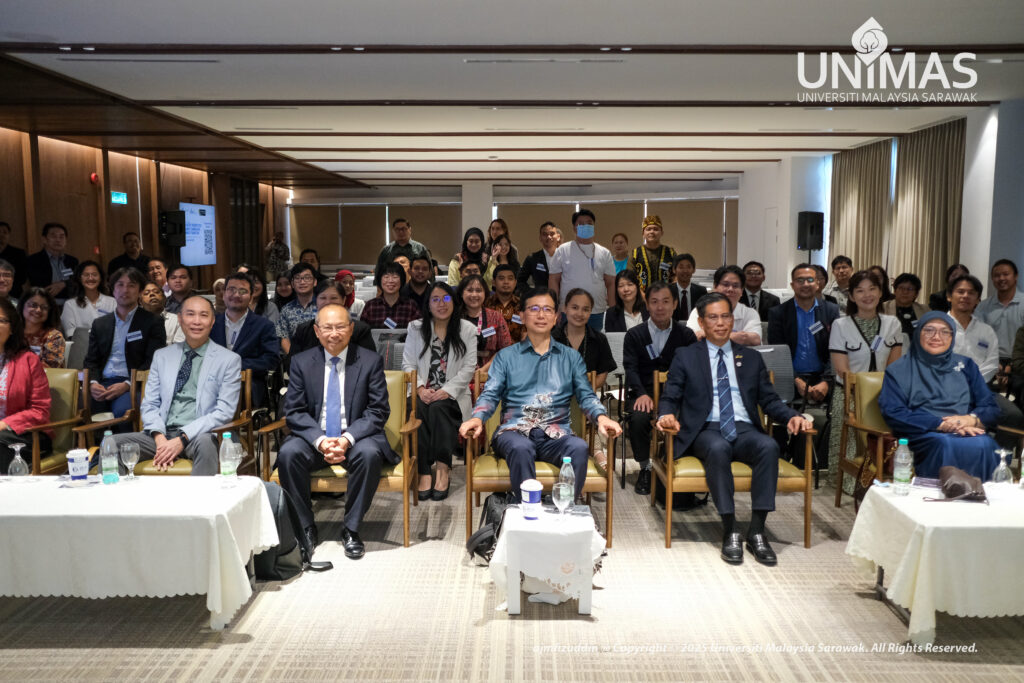
13.3.5 Environmental education collaborate and NGO
Restoring Forests, Connecting Cultures: Planters, UNIMAS and Zen University Students in Sabal Forest Reserve
On 4 November 2025, UNIMAS Plant Science (PLANTERS) students from the Faculty of Resource Science and Technology teamed up with Zen University students from Japan, the Japan–Malaysia Association (JMA), the Forest Department Sarawak (FDS), and local villagers for a collaborative reforestation programme at the Sabal Forest Reserve. Planting native tree species to promote ecosystem recovery and forest landscape restoration, the participants engaged in hands-on climate mitigation and cross-cultural environmental learning.
Keyword: Collaborative Reforestation Programme; Forest Department Sarawak (FDS); Japan–Malaysia Association (JMA); Local Villagers; Climate Mitigation; Environmental Learning; Cross-Cultural Environmental Learning; Ecosystem Recovery; Forest Landscape Restoration.
Reference Link: Restoring Forests, Connecting Cultures: Planters, UNIMAS and Zen University Students in Sabal Forest Reserve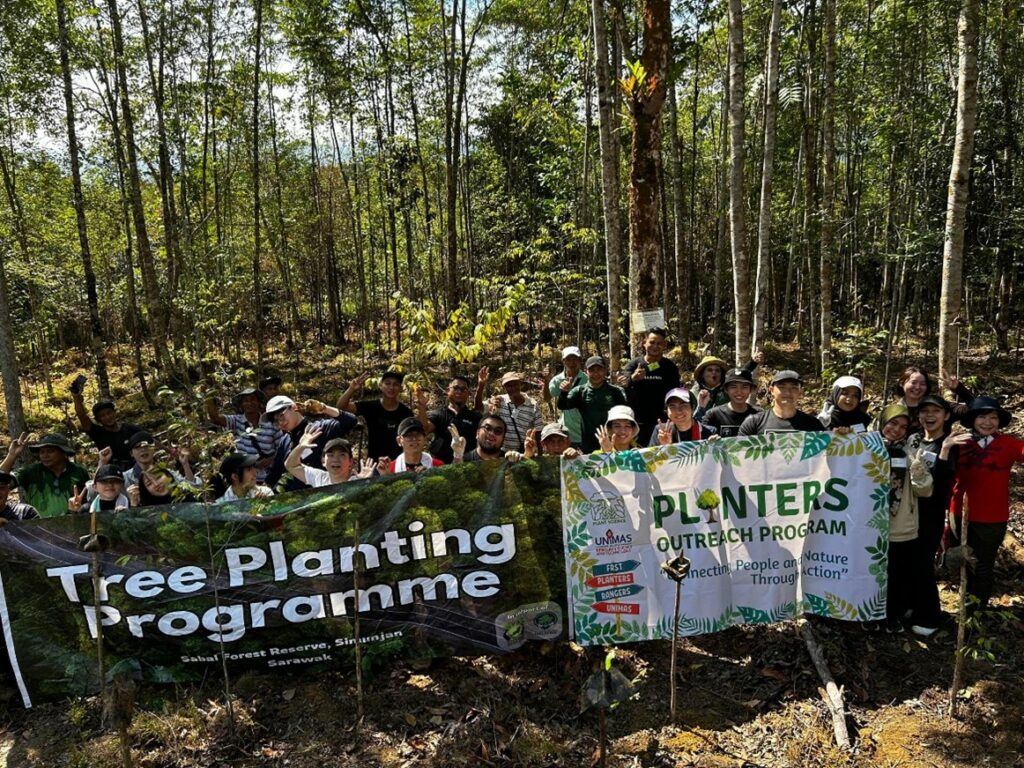
UNIMAS students hold seminar on environmental awareness
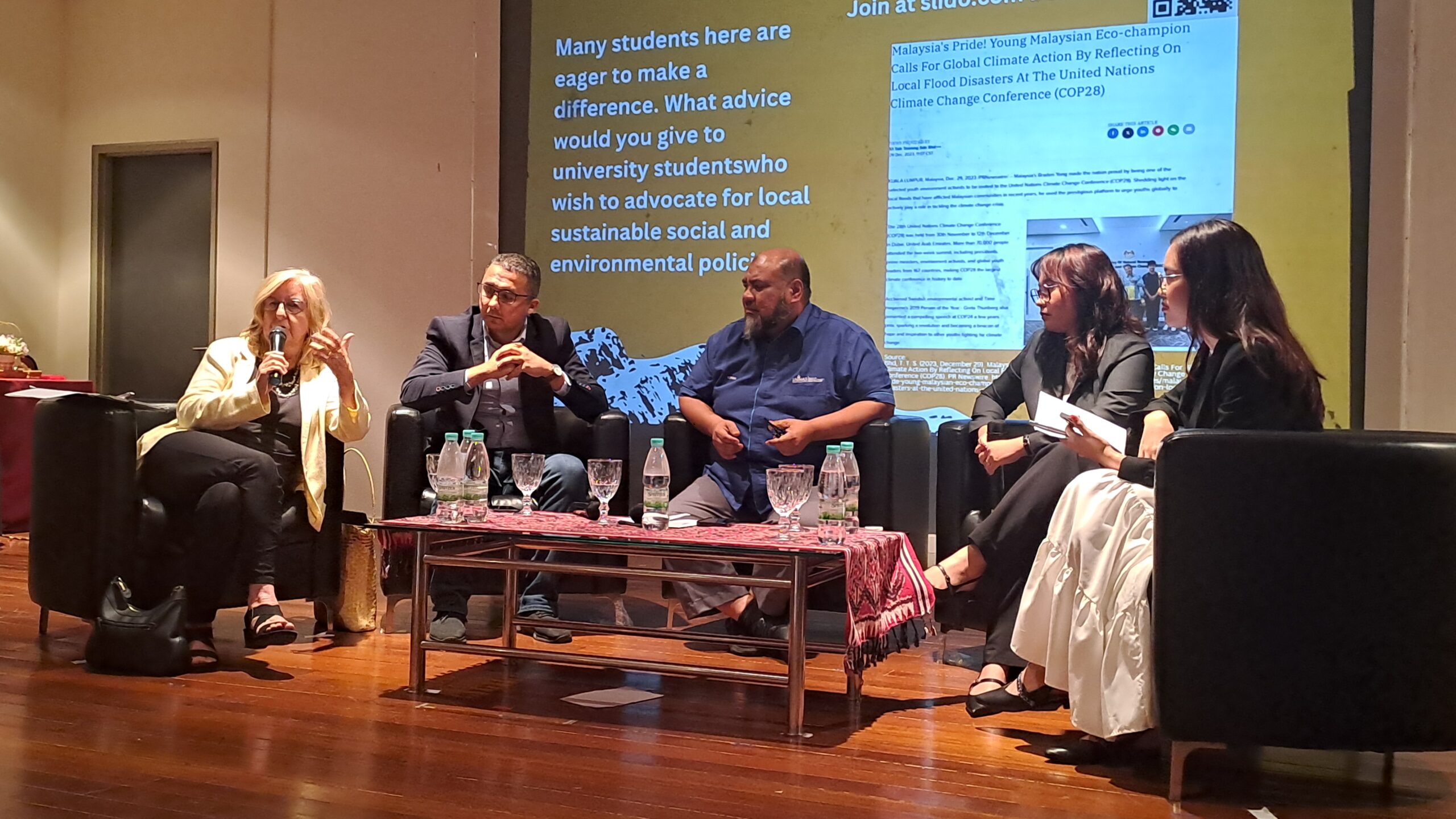
On 7 January 2025, Strategic Communication students from Universiti Malaysia Sarawak (UNIMAS) organized an environmental awareness seminar titled "Environmental Awareness: From Fear to Fuel", designed to help participants channel climate anxiety into positive, practical environmental action. Featuring expert panelists from UNIMAS's Human Resilience and Potential Centre, the Institute of Sustainable and Renewable Energy (ISuRE), and the Mental Health Association Sarawak (MHAS), the event addressed the psychological impacts of natural disasters like floods while encouraging small, impactful lifestyle changes such as sustainable consumption through thrifting. By integrating mental health coping strategies with actionable sustainability practices, the seminar directly supported SDG 4 (Quality Education), SDG 12 (Responsible Consumption and Production), and SDG 13 (Climate Action) by fostering community climate resilience, emotional well-being, and proactive environmental stewardship.
Keyword: Environmental Awareness Seminar; Environmental Education; Mental Health Association Sarawak (MHAS); Institute of Sustainable and Renewable Energy (ISuRE); Climate Anxiety; Community Climate Resilience; Environmental Stewardship; Climate Action.
Reference Link: UNIMAS students hold seminar on environmental awareness
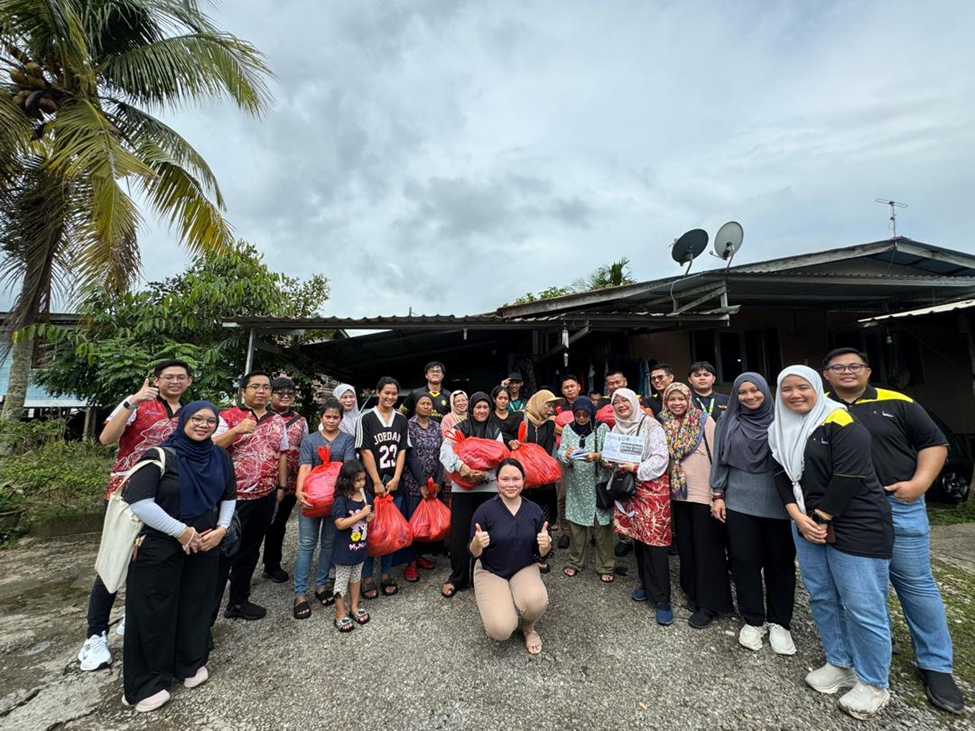
Post-Flood Assistance Program February 2025: Collaboration between the UNIMAS Civil Engineering Department, UNIMAS Water Centre, PEKAMARA, and Yayasan Hasanah to Aid Affected Communities
From 17 to 19 February 2025, the Civil Engineering Department at UNIMAS, in collaboration with the UNIMAS Water Centre, PEKAMARA, and Yayasan Hasanah, executed the Sarawak Prihatin Flood Mission. Mobilizing around 50 volunteers including UNIMAS staff, Civil Defence Force (APM) personnel, and engineering students. The team provided vital post-flood assistance to five severely affected villages: Kampung Siol Kandis, Kampung Kudei, Kampung Endap, Kampung Tanjung Tuang and Kampung Hulu Serian. Over three days, volunteers distributed essential food rations and hygiene kits to aid family recovery while offering civil engineering students invaluable hands-on experience in disaster response and community rehabilitation.
Keyword: Collaboration; PEKAMARA; Yayasan Hasanah; Hands-on Experience; Engineering Students; Disaster Response; Community Rehabilitation; Community Engagement; Disaster Resilience.
Reference Link: Post-Flood Assistance Program February 2025
13.4 Commitment to carbon neutral university
13.4.1 Commitment to carbon neutral university
Universiti Malaysia Sarawak (UNIMAS) is committed to advancing climate action through a comprehensive institutional approach that integrates sustainability into governance, teaching, research, campus operations, and community engagement. Guided by the UNIMAS Low-Carbon Campus Roadmap 2030, the UNIMAS Sustainability Masterplan 2021–2025, the UNIMAS ESG Policy, and the UNIMAS Energy Policy, the university has established a clear pathway towards becoming a low-carbon and climate-resilient campus. These frameworks align UNIMAS with the Sustainable Development Goals (SDGs), Malaysia's climate commitments, and Sarawak's green economy and climate resilience agendas.
The UNIMAS Low-Carbon Campus Roadmap 2030 serves as the university's primary climate action framework, outlining strategic measures to reduce greenhouse gas emissions through six strategic pillars: energy efficiency, greenhouse gas inventory, circular economy and waste management, capacity and capability building, sustainable innovative solutions, and low-carbon mobility. The roadmap establishes measurable targets, including a 30% reduction in energy consumption and increased renewable energy share, a 45% reduction in greenhouse gas emissions, and strengthened climate literacy and sustainability expertise across the university community.
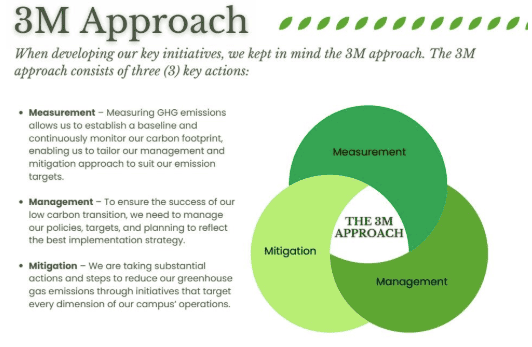
To support evidence-based climate action, UNIMAS adopts a Measurement, Management and Mitigation (3M) Approach, which enables the university to systematically monitor carbon emissions, implement targeted decarbonisation strategies, and evaluate progress over time. Through its GHG Dashboard and greenhouse gas inventory system, UNIMAS monitors institutional emissions and sustainability performance. The greenhouse gas inventory can be categorised into three scopes: Scope 1, covering direct emissions from university-owned or controlled sources; Scope 2, covering indirect emissions associated with purchased electricity; and Scope 3, covering other indirect emissions across the university's value chain, such as commuting, business travel, and waste generation, where included in the reporting boundary. This classification helps identify major emission sources and supports the development of targeted carbon-reduction strategies. The roadmap also emphasises annual performance reviews and continuous monitoring to evaluate progress towards long-term carbon reduction targets, reinforcing transparency, accountability, and data-driven decision-making in UNIMAS's climate initiatives.
Through its ESG Policy, UNIMAS formally commits to reducing its environmental footprint by increasing renewable energy adoption, improving energy efficiency, reducing greenhouse gas emissions, conserving biodiversity, enhancing sustainable resource management, and strengthening stakeholder engagement. The policy further establishes governance structures, reporting mechanisms, and implementation committees responsible for monitoring sustainability performance and ensuring institutional accountability. Annual ESG reporting provides public disclosure of sustainability-related metrics and progress, reinforcing transparency in climate governance.
Complementing these efforts, the UNIMAS Energy Policy promotes efficient energy management, low-carbon operations, renewable energy utilisation, regular energy audits, and campus-wide participation in energy conservation practices. The policy establishes a structured energy management system supported by dedicated committees, energy performance monitoring, and continuous improvement mechanisms aimed at reducing carbon emissions and optimising resource use throughout the university.
Keyword: Commitment to carbon neutrality, UNIMAS Low-Carbon Campus Roadmap 2030, 45% greenhouse gas emissions reduction target, GHG inventory and GHG Dashboard, Scope 1, Scope 2 and Scope 3 emissions monitoring, Decarbonisation strategies and carbon-reduction targets
13.4.2 Carbon neutral: achieve by date
Universiti Malaysia Sarawak (UNIMAS) has established measurable sustainability and climate action targets to be achieved by 2030, demonstrating its commitment to reducing greenhouse gas (GHG) emissions and mitigating climate change impacts. The institution aims to achieve a 30% reduction in energy consumption, a 45% reduction in greenhouse gas emissions, and a 40% reduction in waste generation by 2030. These long-term targets are supported by monitoring of major emission sources and carbon reduction initiatives, including improvements in energy efficiency, management of staff transportation emissions, waste minimization programmes, enhancement of carbon sinks, and water conservation efforts. By setting clear and time-bound emission reduction goals, UNIMAS is advancing its institutional strategy towards a lower-carbon and more sustainable campus.
Keyword: 2030 Target, 45% GHG Reduction, Emission Reduction Target, Time-bound Target, Greenhouse Gas Reduction.